Case Studies · Product Manager · 2026
Selar
Selar: Case Study
Product Manager, Selar (Nigerian creator commerce platform)
Scope: Membership communities, storefront, payments, dashboard experience, trust and safety, growth, developer platform, learning products
Overview
Selar helps African creators sell digital products, courses, memberships and tickets. As a Product Manager, I owned features from problem framing through PRD, launch copy and cross-functional handoff. This case study covers the work I am proudest of, grouped by the problem each piece solved.
1. Selar Communities (Membership Communities)
Problem: Creators ran their audiences across WhatsApp, Telegram and email groups. Billing and access control were manual, because they had to add and remove people by hand. They could see revenue but not who was engaged or about to churn. Members struggled to know what a membership included before paying, and content, chat and updates lived in different apps.
What I did: I set and achieved three goals: launch fast (a paid membership published in one sitting), grow recurring revenue and improve retention. I drew a clear MVP line: no global social network, no native video infrastructure (live runs on YouTube), and responsive web before a native app.
The core product:
- Tiers: free, premium and exclusive layers, each controlling what members can see and do.
- Spaces: posts and media, events with RSVP, and product spaces to sell directly to members.
- Automatic access: granted and revoked by payment status, so creators stop managing groups by hand.
- Discussions, messaging and member management in one place.
- Public membership pages with tier comparison and content previews, so members know what they are paying for.
- Notifications across in-app, email and push.
- Plan gating: available on Pro, Turbo and Turbo Plus plans.
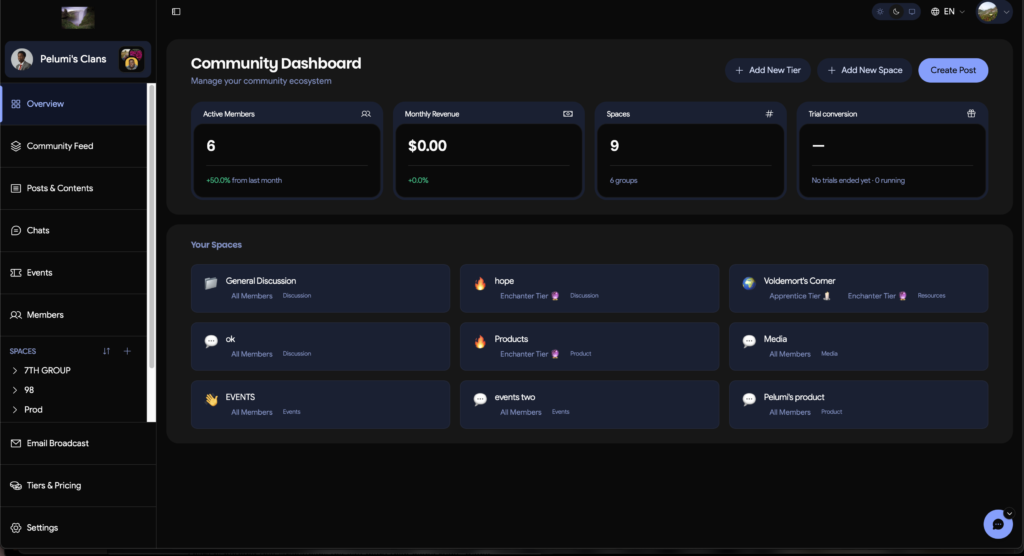
I also wrote the creator-facing feature page and FAQ.
Deliverables: Communities PRD, success metrics framework, feature page copy
Outcome: Over 500 creators created communities in the first month, and Communities processed ₦10 million in GMV within three months.
Community Membership V2
After launch, I scoped the next wave from what creators needed to run and grow their communities:
- Free trials on paid tiers, with a payment method upfront and one trial per member to prevent abuse.
- Combined tier and perks setup: a two-step flow collapsed into one form with a live preview of what members will see.
- Adding members directly by email or CSV import, so creators can migrate existing WhatsApp and Telegram audiences with a tier assigned on the way in.
- Polls as a new space type for voting and feedback.
- Show Love: members can financially support creators beyond their subscription.
- Faster subscription upgrades, removing the cart step by reusing saved payment methods.
- Community managers with permissioned moderation, and badges to recognise loyalty and supporter levels.
- Collab Space Groups, where multiple creators co-host events, joint content drops and shared campaigns across communities.
Deliverables: V2 PRD, V2 feature specification
Membership Analytics and Tracking
I wrote a PRD covering two layers. The first is 18 platform-level outcome metrics for internal reporting, including MRR, renewal rate, churn and active subscribers. The second is per-membership overviews and per-member behavioural profiles for creators, built to support churn prediction and retention action.
Deliverables: Analytics and Tracking PRD, creator analytics dashboard specification
2. Storefront V2
Problem: Selar’s storefront treated every creator the same. Most storefront builders optimise for function: upload a product, set a price, publish. But selling is also expressive. A teacher, a premium brand and a campaign-driven seller need different storefronts, and a generic SaaS look weakened trust and perceived product value.
What I did: I reframed the storefront from a selling tool into a brand identity system for creators. Instead of one storefront, I defined a set of culturally rooted templates, each a distinct selling personality, with African names chosen for meaning and not decoration:
- Tuntun (Yoruba): a clean, balanced default for any creator.
- Asana (Efik): minimal, with products first.
- Ogbaragba (Ikwerre): elegant and premium.
- Onye Nkuzi (Igbo): structured, for educators and course sellers.
- Uyai (Akwa Ibom): visual, for beauty, fashion and lifestyle.
- Kyau: soft and emotional, for art and taste.
- Otuturma (Ebira): bold and high impact, for launches and campaigns.
The bet was simple: when a storefront feels like the creator, trust rises faster, products feel more valuable and buyers understand the brand instantly.
Deliverables: Storefront V2 concept and positioning, template system, launch copy
Outcome: 100% of sellers switched to the new storefront, and churn dropped from 10% to 8%.
3. Dashboard Revamp
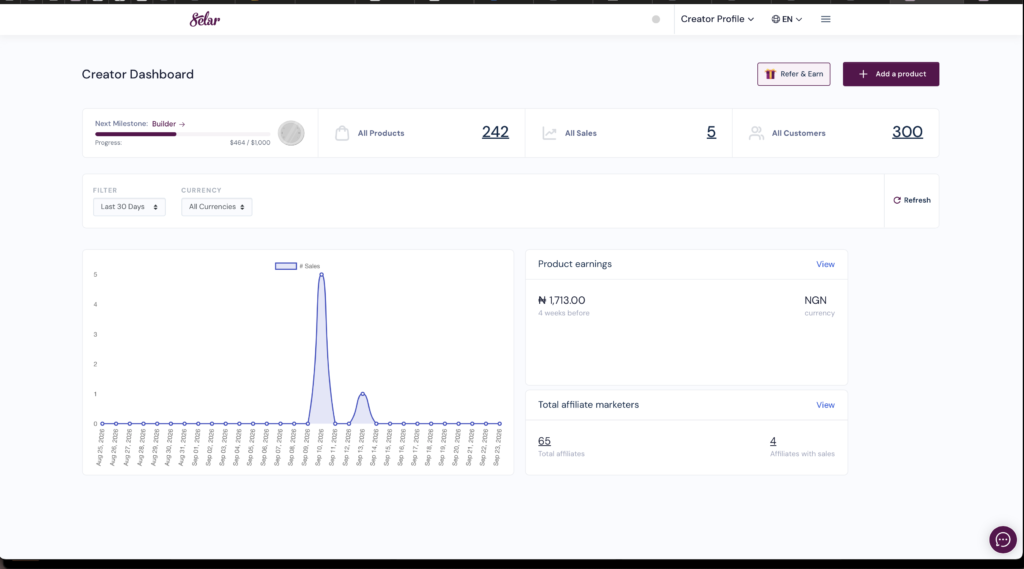
Problem: The seller dashboard had grown feature by feature. The sidebar held 17+ top-level items, the interface felt cluttered, screens felt inconsistent, money was hard to read across currencies and sellers could not easily see how their business was performing. New sellers could not find core features and support tickets kept asking where things were.
What I did: I owned the revamp end to end, working across five layers:
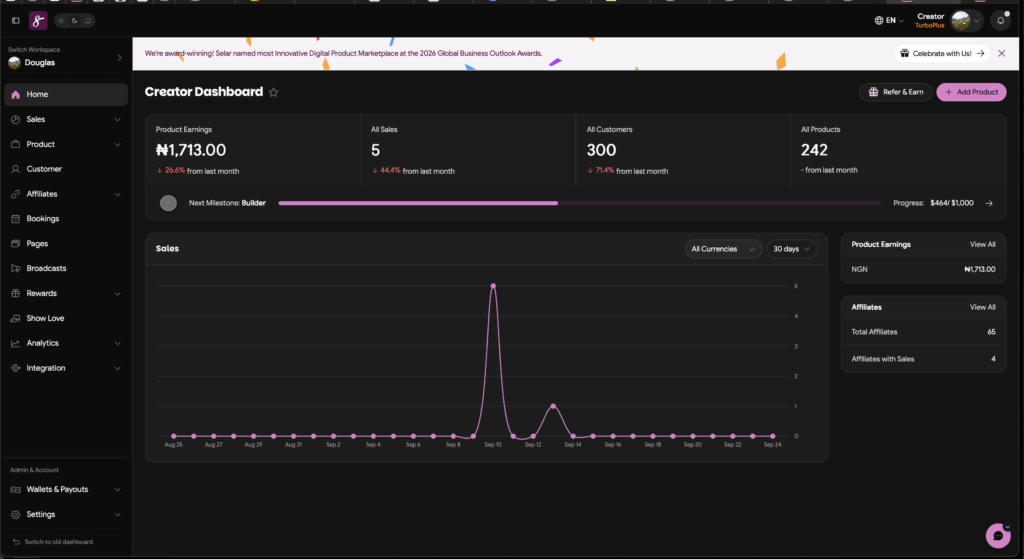
- Navigation and information architecture: I audited every item and rebuilt the sidebar around seller jobs to be done: Home, Sales, Products, Customers, Affiliates, Marketing and Storefront, and Rewards. Admin sits pinned at the bottom, with dedicated hubs for Wallet and Payouts and for Integrations, and settings grouped into General, Store, Payment, Security and Billing. I wrote the PRD and built a working prototype so design and engineering could react to something concrete before build.
- Interface design: I improved the look and feel of the dashboard itself. That meant a cleaner, more consistent visual language, a collapsible sidebar that gives sellers more working space, a profile menu for account actions, and consistent icons and spacing across screens, so the product felt simpler and more trustworthy to use every day.
- Screen redesigns: I scoped the redesigned screens: the dashboard overview with analytics and Refer & Earn, a sales tab that handles many currencies, sale details, creator-initiated refunds, chargebacks and disputes, the wallet and withdrawal flow including USD payouts, payout settings with 2FA, affiliate challenges, coupons, integrations, billing and plans.
- Analytics: I defined the metrics sellers see on their analytics page, with all income shown in the seller’s default currency. That includes gross versus net sales, sales count versus units sold, conversion, abandoned transactions and coupon performance.
- Subscription dashboard: I wrote the acceptance criteria for plan display, currency handling, checkout and payment states, failed payment recovery, upgrades and downgrades, and the auto-renewal toggle.
- Build review: I checked the V2 dashboard against the designs and logged issues for fixes before release.
Deliverables: IA audit and sidebar PRD, interactive prototype, dashboard screen inventory, analytics metrics PRD, subscription dashboard acceptance criteria, V2 build issue log
Here is before and after
6. Refer & Earn
Problem: Growth leaned too heavily on paid acquisition. Selar’s community was already recommending the platform informally, with no structure to reward it.
Deliverables: Partner Program PRD, Refer & Earn T&Cs
7. Course Quizzes
Problem: Course creators could not test learner understanding, which limited how serious a learning product they could sell.
What I did: I wrote the PRD for Tests and Quizzes inside Selar courses.
Deliverables: PRD, feature specifications